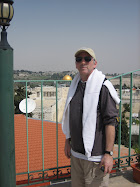
WELCOME TO THE YOGA AND JUDAISM CENTER BLOG

The primary focus of this yoga is not on physical exercise, but is rather "yoga beyond the mat," focusing on meditation, mysticism, philosophy and psychology.

Likewise, the focus on Judaism here is on the spirituality within Judaism, not the religion.

Your comments and posts are welcome.

25% DISCOUNT ON ALL BOOKS PURCHASED AT LULU

The printer of my books, Lulu, has instituted a new pricing program that helps promote purchases direct from their site rather than from online retailers. It allows me to provide a discount on the price for items purchased from them. So all of my titles purchased through Lulu are now set at 25% off the list price. Even for other sites that provide for free shipping, the discount from Lulu should still provide some savings, even with the shipping charge. So shop at Lulu and save: http://stores.lulu.com/yajc or www.lulu.com.

CURRENT TEACHING SESSIONS

JEWISH YOGA MEDITATION AND MYSTICISM. The great spiritual traditions of both East and West have throughout the ages promoted various forms of meditation as important practices to foster spiritual awakening and development. As an independent practice, to supplement other spiritual or religious practices, for stress management and relaxation, or all of the above, this course will provide the theoretical framework and practical technique for a traditional yoga-based practice derived from an ancient and time-honored Himalayan tradition. Included will be basic breathing and stress reduction techniques. They lay the foundation for access to avenues leading to the stillness within. Connections will also be made throughout to similar principles found in Jewish mysticism. The final session will cover Jewish meditation utilizing Hebrew phrases in place of yoga mantras and a Jewish healing meditation practice called Ruach El Shaddai/Breath of Balance, employing the practical application of Hebrew Kabalistic concepts in an advanced healing meditation. Depending upon the pace and amount of material covered in each session, the class will consist of five to ten 90 minute sessions meeting once a week.

Steven J. Gold, BA Antioch College, Philosophy and Religion; JD Emory Law School, is the founder/director of the Yoga and Judaism Center in Atlanta, GA and the author of Yoga and Judaism (2007) Ivri: The Essence of Hebrew Spirituality (2010), Torah Portion Summaries; With Insights from the Perspective of a Jewish Yogi (2010), and Basic Spiritual Principles (2011). He has been an initiate, student, practitioner and teacher in a Himalayan meditation tradition for over 30 years and a student of Kabala and Jewish Spirituality for several years. He developed a hybrid Jewish Yoga Meditation and Healing Meditation which is the focus of these sessions.

Date Series Begins: January 22, 2012, and will continue on successive Sunday afternoons thereafter, until completed

Time: 12:15 PM to 1:45 PM.

Location: Vedanta Center of Atlanta; 2331 Brocket Road, Tucker, GA 30084; 770-938-6673. (Corner of Adrian and Brockett, one block from LaVista.)

Cost: Free. Donations accepted, no reservations needed. Open to the public.


Note: These sessions are cumulative, and there is benefit to taking all or most in the series, but drop-ins are welcome

PLEASE NOTE: NO CLASS ON FEBRUARY 26. SESSIONS WILL RESUME MARCH 4.


Spiritual Workshop. Basic Spiritual Principles and The Mechanics of Creation in Genesis.


Dates and Time: Four 90 minute sessions on Wednesday evenings: February 22, 29 and March 14 and 21; 7 PM to 8:30 PM. (Please note no session on March 7 due to Purim activities).


Location: Temple Sinai, 5645 Dupree Drive, Atlanta, GA 30327. Please call or email to pre-register: Judy Thomas, 404-252-3073 x 330; jthomas@templesinaiatlanta.org.

Cost: $60.00 for the series of four sessions, which class fee includes a copy of the book Basic Spiritual Principles ($20.00 retail)


Description:

This workshop will have as its focus the text of my latest book, Basic Spiritual Principles. The idea of this book and workshop, as encompassed in the title, is to present in simple and straightforward terms some basic principles related to spirituality and spiritual processes and revelations without getting too complex, involved or abstruse. It provides a framework to help address life’s essential existential questions: Why am I here? Where did I come from? How did I get here? How did ‘here’ get here? Where am I going? What is the purpose of my life? What is life and this thing we call existence? What is it all about? Please note that it doesn’t claim to answer these questions, it only claims to provide a framework, a perspective, an orientation that may be helpful in addressing these questions. The “answers” are a matter for individual self-discovery.

In addition, we will examine an analysis of the opening sentences of Genesis within this framework. Perhaps Genesis is not just a description of the workings of the external universe, but also of the internal universe that exists within each of us. Genesis like you’ve never seen it before!

Included in the class fee is a copy of my new book, Basic Spiritual Principles.


The Wisdom Tradition of Torah Commentary

With the assistance of Brother Shankara, Steve Gold will discuss and dialogue about the aspect of jnana practice within the Jewish tradition and his own personal study process of Torah.

Date: March 4, 2012

Time: 11 AM (preceded by 30 minutes of chanting starting at 10:30 AM)

Location: Vedanta Center of Atlanta; 2331 Brocket Road, Tucker, GA 30084; 770-938-6673. (Corner of Adrian and Brockett, one block from LaVista.)

Cost: Free. Donations accepted, no reservations needed. Open to the public.

About the Presenter

Steven J. Gold, BA Antioch College, Philosophy and Religion; JD Emory Law School, is the founder/director of the Yoga and Judaism Center in Atlanta, GA. He has been a student, practitioner and teacher of spiritual self-realization and its related philosophy and psychology for over forty years, including yoga, Vedanta, kabala and eastern and western mysticism. He is an initiate and practitioner in the Tradition of the Himalayan Masters, as propagated in the West by the late Sri Swami Rama of the Himalayas. He is the author of Yoga and Judaism, Explorations of a Jewish Yogi; IVRI, The Essence of Hebrew Spirituality, 21st Century Perspectives on an Ancient Tradition; Torah Portion Summaries, With Insights from the Perspective of a Jewish Yogi; and his latest book, Basic Spiritual Principles.

Tuesday, September 20, 2011

Mantra Meditation Basics


Mantra Meditation Basics
This article is meant to fill in a few gaps left by other articles on Meditation Basics, Jewish Yoga Meditation, and Hebrew Mantras. The other articles cover the theory and practice of meditation and the use of mantras in meditation, but they don’t address the theory behind the use of mantras. Some meditation researchers, most notably Herbert Benson of Harvard, have come to the conclusion that there is not much significance to the language or form of mantras used during meditation, that any soothing sound (such as “one, one, one”) intoned internally will elicit an equally effective “relaxation response.” The yoga meditation tradition in which I was trained, and I believe most spiritually-based meditation traditions would have no difficulty acknowledging the validity to Benson’s research and findings as to the benefits of meditation practice regardless of the phrase utilized. However, they would also maintain that there are additional benefits if mantras originating from sacred languages are utilized and prescribed by teachers trained in specific meditation traditions. Benson is a scientific researcher, and desires to restrict his focus to what scientific standards and procedures can measure and verify. And his work has made a significant contribution in legitimizing and promoting the benefits of meditation practice. My spiritual teacher, Swami Rama, was also dedicated to scientifically verifying the benefits of meditation. But he eventually came to the conclusion that there were certain spiritual practices and phenomenal realities that could not be scientifically verified due to the limitations of current scientific measurement technologies.
When venturing into a discussion of “sacred language”, it would appear that a leap of faith beyond what science can verify may be required. I do not apologize for that, but I can attempt to explain it in support of its validity. I am a proponent of the concept that there exists a mode of perception and functioning that lies between the rationality generally associated with the functions of the logical, scientific, reasoning mind, and the irrationality generally associated with emotional responses that over-rule the mind in certain circumstances. This other mode of operation is what I call the “non-rational” or “intuition”. I have also heard it called the “arational”. It is a mode of perception and operating faculty that can be developed through meditation. There is no way to scientifically verify or confirm its existence, and thus it can be said that it requires an act of faith to believe in it. I would prefer to say that it requires the cultivation of an inner sense of experience and knowledge that it in fact does exist. It is what mystics and spiritually advanced beings throughout times and cultures have attempted to identify in their literature and artistic expressions. One either accepts the validity of this assertion or one doesn’t. What follows is a spiritual/mystical description about sacred language and the origin and operation of mantras. Some of the below is excerpted and revised from my book, IVRI: The Essence of Hebrew Spirituality.

Biblical Hebrew and Sanskrit are sacred languages because they are spiritual languages. Why are they spiritual/sacred, and how is that designation distinguished from other languages or usages that do not have those qualities, from the mundane and the profane?

Sometimes the distinction between the sacred and the mundane is dependent on context. A glass of wine imbibed during an ordinary dinner does not carry the same significance as a cup of wine used in a religious ritual, even though it may be the same wine. Sometimes tradition, ritual, or legend may ascribe spiritual connotations to things or places. Throughout the world, there are temples, shrines, mountains, valleys, rivers that have become imbued with spiritual significance. It can be maintained that since everything and all activity is a part of Divinity, everything is sacred, which is true to an extent. But there remain degrees of specialness which render some activities in some contexts more special, and thus “sacred”, based upon the factors described above. Going for a leisurely swim is not of the same quality as a ritual immersion. Concerning the profane, perhaps it is basically nothing more than the abuse of the sacred.

The origins of sacred languages such as Biblical Hebrew and Sanskrit are lost in the mists of time and myth. A general mystical conception is that language can be traced back to sound, and all sound has its roots in Primordial Divine Sound. Divine Sound emanates out of Primordial Divine Fire, which is also the source of Divine Light. All manifest existence, known to the external and internal senses, is a result of an interchange between Divine Light and Divine Sound, which possesses limitless possible permutations. The Primordial Divine Fire has also been referred to as a Cosmic Magnet or Cosmic Electricity. I like the characterizations of a Cosmic Generator, a Cosmic Dynamo.

In any event, out of the Nothingness that is paradoxically the unmanifest potentiality of Everythingness, this Fire, this Dynamo, generates sound as well as light. Our spiritual ancestors internally “heard” the “roar” of the Divine Fire, the “hum” of the Cosmic Dynamo, the first emanation of Divine Sound. It is what Moses encountered in the burning bush. It is why the first utterance of the ancient Rishis in the Vedas is “agni”, which means fire. As it worked its way through the layers of the inner realms, it eventually emerged from the lips of ancient sages as chants, as strings of mantras. That is why both the Torah and the Vedas are chanted, because they first emerged as sounds which morphed into chants; first, wordless chants, and then chants with words, with language. Eventually, the oral language was reduced to the writing found in ancient Hebrew and Vedic scriptures. These languages are sacred because of their close connection to the unmanifest realm of Silence, of the paradoxical Soundless Sound, which is their Source. Other languages are derivatives and thus further removed, and therefore not qualitatively sacred in the way that these two languages are sacred. Properly understood and employed in meditative practices, as discovered and developed by the ancient sages of the Hebrew and Vedic spiritual traditions, utilization of mantras, which are phrases from the scriptures in which these languages were written, can assist one in awakening, nurturing and expressing their innate spirituality. Through this process, people can approach wholeness, and each individual can become more cognizant of their true and deep individual purpose and meaning, enabling them to become more conscious and joyous participants in the wonder of life. This was the revelation and mission of Abraham, confirmed and forwarded at Mt. Sinai, and of the Rishis of the Himalayas.

Silently internally intoning mantras as part of a meditative practice incorporates several aspects that are beneficial to spiritual development and expression. Mantras operate from the outside in and from the inside out. Invoking a mantra on the surface level serves as an anchor to assist in plumbing the inner depths from which the mantra originated. One should not hold on to the external form of the mantra as it meanders its way within, but should rather allow it to change form as it progresses. At such a point, one becomes aware that the mantra will take on a life of its own, and that you are not repeating it, but rather you are listening to it as it generates itself without your assistance. Allow it to change and morph and keep on listening. The surface level invoking of a mantra also resonates with its source deep within, and initiates a process whereby it is energized at its source and seeks access to the surface. At some point, the inside out and the outside in paths connect, creating an unbroken two-way avenue for its expression both within and without. This avenue can be broadened and strengthened through repeated practice until it remains unbroken through all of life’s activities. This results in “meditation in action”, in which all of life’s activities are enlivened and enriched by one’s meditative presence.

Invoking mantras also facilitates subtle structuring of inner energies beneficial to spiritual development and expression. All mantras have their origins in the Silence from which they emerged, and eventually lead us back to that spiritual ground of Silence. However, specific mantras vary in the effects they produce along the way back to their common source. They are aids assisting to address subtle inner purification and empowerment. Experiment with them, beseech the assistance of Divine Guidance, and find out for yourself!

0 comments: